
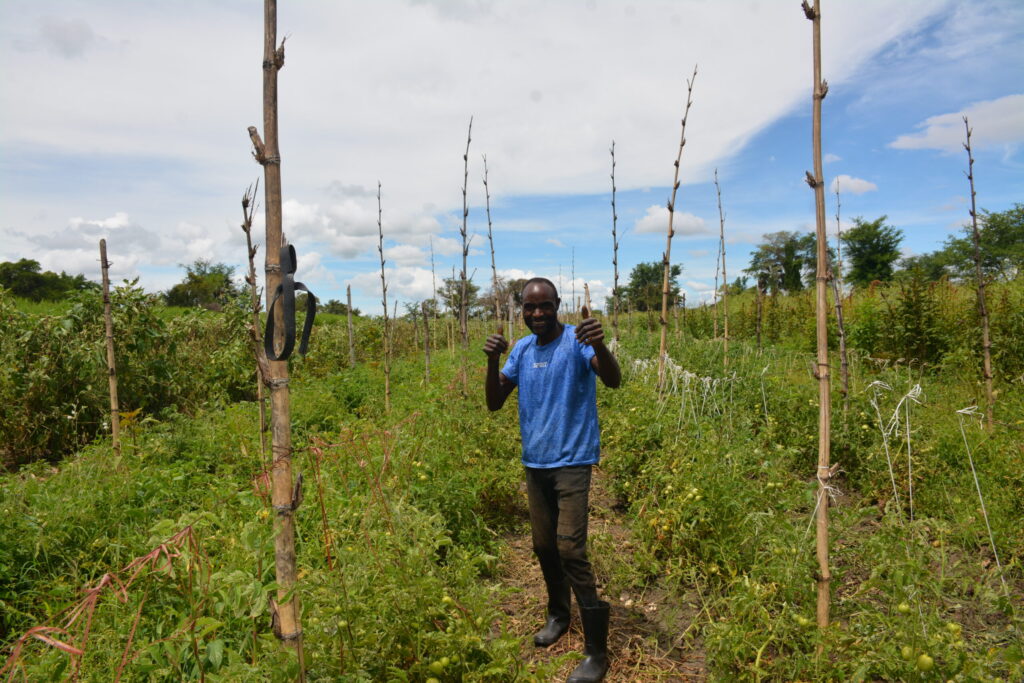
Raphael Moyo has never been short on land, water, or the willingness to work hard. Like many smallholder farmers, what he lacked was capital.
Mr. Moyo is 50 years old, a farmer in Nachili Village, and a divorced father of seven. Keeping his children fed and in school rests on his shoulders, and for years farming alone didn’t make that easy. “Yes, in the past I had been farming,” he says, “but I often failed when my crops were attacked by diseases due to limited resources.” Without money for fertilizer and pesticides, a single outbreak could wipe out a season’s work.
That began to change in October 2023, when Shanta Village Partners launched a Community Bank in Nachili Village. The Community Bank offers affordable loans to rural households so they can invest in income-generating work, build savings, and strengthen their livelihoods.
In the first lending cycle, Mr. Moyo borrowed the equivalent of $56. He put it straight into his vegetable garden, buying rape (mustard greens) and cucumber seeds, fertilizer, and pesticides. Then he timed his harvest well, selling his rape when demand was high. Rape brought in the equivalent of $395, and cucumbers another $226. That small loan had turned into about $621 in income.
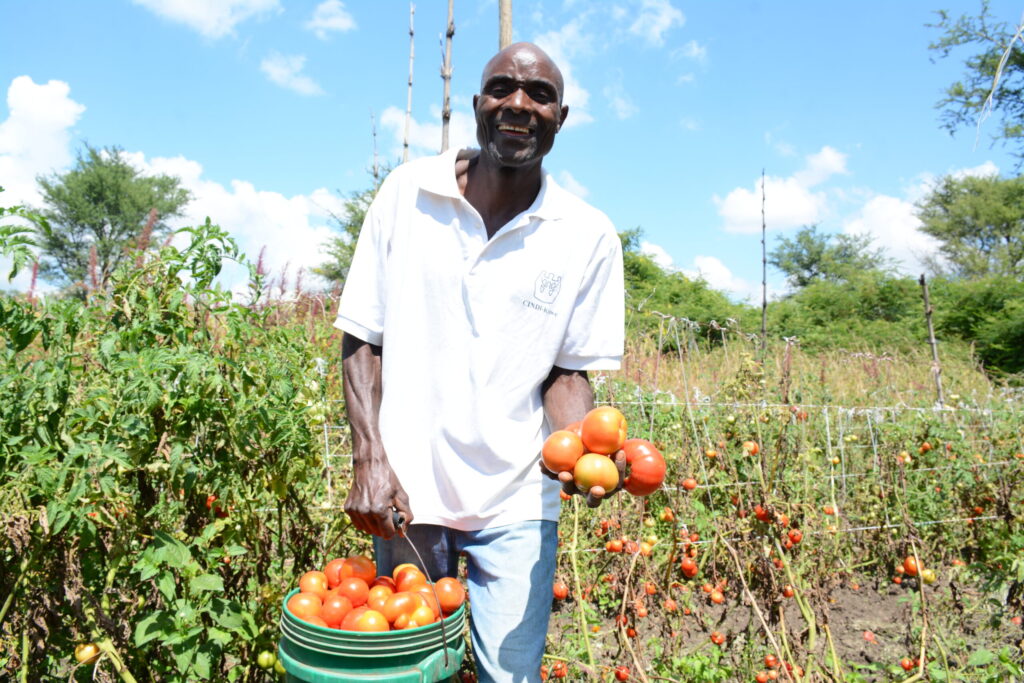
He repaid reliably, and the Community Bank committee took notice, approving a second loan of the same size. This time he grew rape and tomatoes, earning the equivalent of $451 from rape and $209 from tomatoes.
By the third lending cycle in November 2025, he qualified for a larger loan, the equivalent of $282. He expanded, planting bigger plots of rape and tomatoes and buying more fertilizer and crop protection. Then heavy rains damaged part of his garden. Even so, he earned about $169 from rape and nearly $1,270 from tomatoes, his best harvest yet.
Across three cycles, Mr. Moyo has borrowed the equivalent of $395 in total. His farming has brought in about $2,720, a net gain of roughly $2,325.
The numbers matter most for what they’ve made possible at home. In Nachili Village, many children never get past primary school because their families can’t afford it. Mr. Moyo’s farm income has let him pay school fees consistently and keep his children learning. In 2025, one of his children graduated with a degree in civil engineering. Another is studying pharmacy at college, and two more are in grades 11 and 12. In a community where these milestones are rare, his family is reaching them one after another.
His household is more secure, too. The family has a reliable food supply throughout the year, with surplus produce to sell. He was able to buy spare parts and repair his hand tractor, so he can now prepare larger areas of land more efficiently. Day to day, there is simply less financial pressure.
“The good thing I have found since Shanta started working with us is that things have become easier for me,” he says. “I had challenges finding money to buy chemicals and fertilizer needed for my crops to grow well.”
His neighbors have noticed. Inspired by his results, other Community Bank members in Nachili Village are investing their own loans in farming. And Mr. Moyo isn’t finished.
“My dream is to become a big farmer and help others in my community realize the potential that lies in agriculture,” he says. “Success comes to those who remain determined and make good use of the opportunities available to them.”